
Preview
Artist's Statement
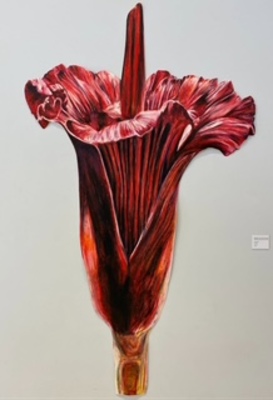
The corpse flower embodies the tension between life and death — the way we long to draw others close, yet sometimes instinctively repel them. Human organs often evoke disgust, yet they are also the very instruments of life and breath. I chose to portray the corpse flower in oil pastels to express this intertwining of devastation and beauty within the human experience: the joy that exists in life, tainted by sin, death, loss, and grief.
The corpse flower, or Titan Arum (Amorphophallus titanum), is an endangered plant with fewer than 1,000 remaining in the world. It takes seven to ten years to produce its first bloom, and during subsequent bloomings, it emits the smell of decaying flesh — a scent that both repels predators and attracts carrion flies.
To me, its symbolism lies in this contradiction: a desire to be seen, to be wanted, to reach toward connection, while simultaneously pushing others away in self-protection. It exists at the boundary of life and death, embodying quiet resilience and raw beauty. The corpse flower reminds us that even amidst decay and hardship, life can emerge — and beauty can persist — in the most unexpected places.
Dimensions
72 x 24 in
Year created
1-2026
Rights
© The Author(s)
Recommended Citation
Miller, Felicity A., "Résiliente au cœur des ruines (Resilient at the heart of the ruins)" (2026). SACAD: Creative Activities. 147.
https://scholars.fhsu.edu/sacad_art/147